


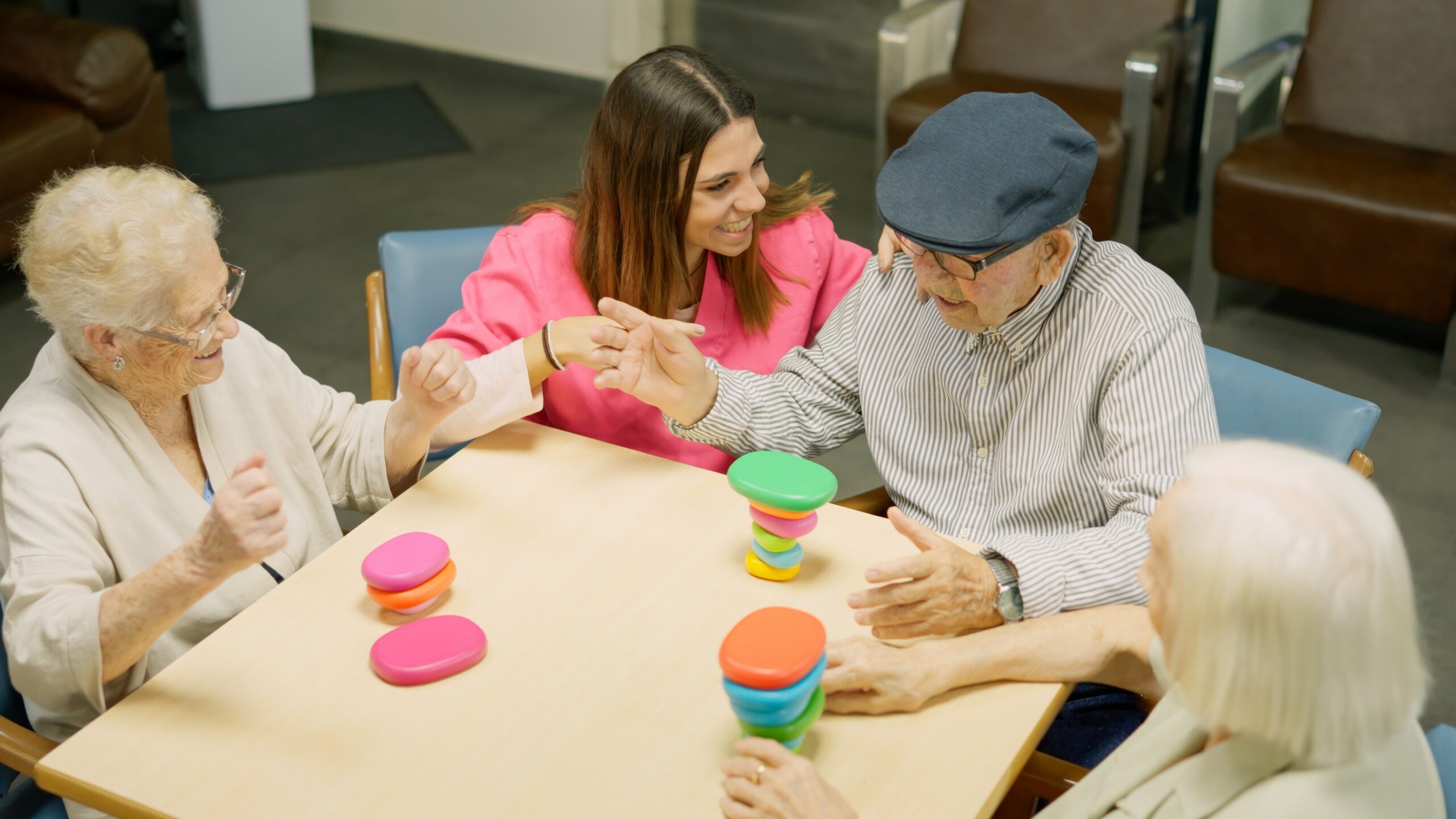
Cognitive stimulation is part of the cognitive-oriented treatment approaches, which are non-pharmacological therapies. Cognitive-oriented therapies include cognitive stimulation (CS), cognitive training (CT) and cognitive rehabilitation (CR). This article deals exclusively with the effectiveness of cognitive stimulation.
According to current research, cognitive stimulation is the most effective of the three approaches mentioned for people with mild-moderate dementia. It is also listed in the current guidelines. Its aim is to improve cognitive and social skills.
The methods of cognitive stimulation can be carried out by caregivers or therapists. A distinction is made between two forms of the method:
Reality Orientation Therapy (ROT):
A typical situation with ROT would be: A caregiver or therapist sits with the person with dementia and asks specific orientation questions:
- “What day is it today?”
- “Where are we right now?”
- “What’s your name?”
- “What was on the news yesterday?”
In the process aids are used:
- Orientation boards
- Calendar
- Watches
- Signs with name/location
ROT is an older model that was often perceived as confrontational. For example, if a patient with dementia expressed the wish “I want to go home”, even though they were already at home, this was often corrected directly in the past. This approach often led to criticism as well as additional stress and uncertainty for those affected. For this reason, ROT is now used much less frequently in clinical settings. However, it can still be used in a softened and individually adapted form in the home environment.
Cognitive Stimulation Therapy (CST)
CST is the more modern, broader development. It typically takes place in groups of 5-8 patients over several weeks (classic: 14 sessions, 2x per week (approx. 45 min) for 7 weeks).
A typical CST session could look like this:
- Welcome & orientation – discuss date, weather, current topic
- Reminiscence – e.g. looking at old photos, talking about earlier times (“What was Christmas like for you in the past?”)
- Multi-sensory stimulation: touching objects, guessing smells, listening to music
- Implicit learning: Knowledge is absorbed unconsciously, e.g. through games, songs or familiar everyday activities, without it feeling like targeted practice.
The methods of cognitive stimulation can be carried out both in groups and individually [5,8].
What happens in the brain during cognitive stimulation?
The exact mechanisms that trigger CST in the brain are still unclear. However, there are initial indications from imaging studies that CST could affect functional connectivity on the one hand and trigger positive structural changes on the other.
Functional connectivity
In dementia or Alzheimer’s disease, nerve cells die and the connections between them weaken or are lost completely. The hippocampus (a central brain structure for memory and learning) is affected particularly early on , from which the cell loss gradually spreads to neighboring regions.
The following overview shows the most important areas of the brain that can be influenced by cognitive stimulation therapy:
- Hippocampus: The hippocampus is one of the central structures for memory and learning. It plays a key role in storing new information and recalling past experiences. In Alzheimer’s disease, it is one of the earliest and most severely affected brain regions.
- Posterior cingulate cortex (PCC): It plays an important role in recalling personal memories, i.e. remembering one’s own experiences and life story. In Alzheimer’s disease, it is one of the first areas of the brain to lose activity and communicate less effectively with other regions.
- Bilateral parietal lobes: The parietal lobes comprise two functionally distinct areas.
- Postcentral gyrus: The postcentral gyrus processes bodily sensations – i.e. everything we touch, feel or perceive. It helps to link these sensory impressions with memories. In Alzheimer’s disease, the connections to this region remain intact for longer compared to the directly adjacent hippocampus regions.
- The medial parietal lobe: It helps us to perceive ourselves as a person – in other words, to know who we are, where we are and how we relate to other people.
- The lateral parietal lobe: It supports episodic memory – i.e. the ability to remember specific personal experiences. Both areas of the parietal lobe are affected early on in Alzheimer’s and increasingly lose their connection to other regions of the brain.
CST seems to stimulate the brain to make greater use of still intact connections between more distant regions. It therefore actively reorganizes its communication and thus compensates for its damage. One study showed that CST particularly improves the connection between the hippocampus and the postcentral gyrus strengthens. The stronger this connection became, the better the patients performed in memory tests. However, without regular training, these improvements decreased again after three months [1].
Another study showed that CST improves the connections between the posterior cingulate cortex and the medial and lateral parietal lobes strengthens. As a result, those affected are better able to perceive themselves as a coherent person, to recognize their own memories as such, to recall their own life story more easily and to experience themselves as an active person in everyday life and in social situations [6].
It was also shown that patients with a higher level of education and longer professional experience benefit more from the effects, presumably in the sense of the so-called cognitive reserve. A brain that is actively used throughout the lifespan appears to have more functional flexibility [1,6].
Structural changes
Dementia not only causes nerve cells to lose their connections – the brain regions themselves also gradually shrink, a process known as cortical atrophy.
An initial pilot study was able to show that CST can possibly slow down this degradation. In the CST group, the thickness of the cortex in two regions of the parietal lobe, the supramarginal gyrus and the postcentral gyrus, remained stable or even increased slightly, while in the control group it continued to decrease as expected. Both regions are involved in language processing, verbal memory and body perception.
Most significantly, the more cortex thickness was preserved in these regions, the better the patients performed in cognitive tests – a direct correlation between structural preservation and function in terms of cognitive performance [7].
Research to date on the effects of CST on the brain is still in its infancy. The existing studies usually have very few participants and are difficult to compare methodologically. The effects described should therefore be seen as promising initial indications, not as confirmed facts. In order to really understand what CST does to the brain, larger and more comparable studies are needed in the future.
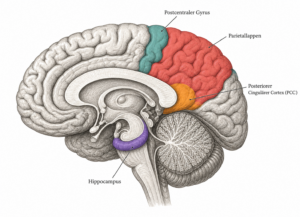
Figure 1: Anatomical representation of relevant brain regions affected by cognitive stimulation therapy. Created with ChatGPT on 12.05.2026 (OpenAI, 2026).
How does cognitive stimulation therapy work for people with dementia?
Studies show that CST particularly strengthens general thinking skills. This is measured using standardized tests such as the MMSE and the ADAS-Cog, which test various mental abilities such as memory, orientation, attention, language and spatial thinking. [3].
Up to 90% of people with dementia also suffer from psychological and behavioral symptoms, including depression, anxiety, apathy, restlessness, aggression, aimless wandering, delusions or hallucinations. It is not yet clear whether CST can positively influence these symptoms. Some studies report positive effects, while others do not. The research situation is contradictory – and many studies also have very few participants, which makes it even more difficult to draw reliable conclusions [2,3,4]
What forms of dementia can it be used for?
Studies show that cognitive stimulation therapy is particularly effective for mild to moderate dementia. CST has been shown to improve general cognition in both Alzheimer’s and vascular dementia. However, there are differences in the long term: Alzheimer’s patients are more likely to improve in terms of depressive symptoms, while people with vascular dementia show greater gains in quality of life and language skills [9].
Conclusion
Cognitive stimulation therapy is currently the most effective non-pharmacological therapy for people with mild to moderate dementia and has been shown to improve general thinking ability. The big plus point here is that, in contrast to pharmacological options, structural and functional improvements following cognitive stimulation therapy have already been demonstrated in the pilot studies, and without any side effects! When it comes to accompanying symptoms such as depression or anxiety, the research situation remains contradictory.
However, the therapy must be carried out regularly in order to maintain its effect – similar to exercise, which is only beneficial if you stick with it. In view of the limited options for medication and the growing number of people affected, CST offers a promising and completely side-effect-free addition to dementia care – so it’s worth it!
There are also outpatient options for CST therapy in Germany. The best way to find out about CST therapy options in your area is to contact memory outpatient clinics, neurological or psychiatric clinics and regional Alzheimer’s counseling centers. Various telemedicine centers now also offer virtual CST therapy options.
CST is particularly effective in combination with physical training. You can find out more here.
References
- Behfar, Q., Richter, N., Kural, M., Clemens, A., Behfar, S. K., Folkerts, A.-K., Fassbender, R., Kalbe, E., Fink, G. R., & Onur, O. A. (2023). Improved connectivity and cognition due to cognitive stimulation in Alzheimer’s disease. Frontiers in Aging Neuroscience, 15. https://doi.org/10.3389/fnagi.2023.1140975
- Calderone, A., Marra, A., De Luca, R., Latella, D., Corallo, F., Quartarone, A., Tomaiuolo, F., & Calabrò, R. S. (2025). Multisensory Stimulation in Rehabilitation of Dementia: A Systematic Review. Biomedicines, 13(1), 149. https://doi.org/10.3390/biomedicines13010149
- Cao, Y., Wang, N., Zhang, Q., Shen, N., Bai, J., Luo, X., & Liu, Y. (2023). Effects of cognitive stimulation therapy on patients with dementia: An umbrella review of systematic reviews and meta-analyses. Experimental Gerontology, 177, 112197. https://doi.org/10.1016/j.exger.2023.112197
- Desai, R., Leung, W. G., Fearn, C., John, A., Stott, J., & Spector, A. (2024). Effectiveness of Cognitive Stimulation Therapy (CST) for mild to moderate dementia: A systematic literature review and meta-analysis of randomized control trials using the original CST protocol. Ageing Research Reviews, 97, 102312. https://doi.org/10.1016/j.arr.2024.102312
- Gómez-Soria, I., Iguacel, I., Aguilar-Latorre, A., Peralta-Marrupe, P., Latorre, E., Zaldívar, J. N. C., & Calatayud, E. (2023). Cognitive stimulation and cognitive outcomes in older adults: A systematic review and meta-analysis. Archives of Gerontology and Geriatrics, 104, 104807. https://doi.org/10.1016/j.archger.2022.104807
- Liu, T., Spector, A., Mograbi, D. C., Cheung, G., & Wong, G. H. Y. (2021). Changes in Default Mode Network Connectivity in Resting-State fMRI in People with Mild Dementia Receiving Cognitive Stimulation Therapy. Brain Sciences, 11(9). https://doi.org/10.3390/brainsci11091137
- Loureiro, L. M., Bertrand, E., van Duinkerken, E., Laks, J., Marinho, V., Bomilcar, I., Naylor, R., Wong, G., Spector, A., & Mograbi, D. C. (2025). Structural brain changes in people with dementia receiving Cognitive Stimulation Therapy: Preliminary findings. International Journal of Clinical and Health Psychology, 25(4), 100643. https://doi.org/10.1016/j.ijchp.2025.100643
- Paggetti, A., Druda, Y., Sciancalepore, F., Della Gatta, F., Ancidoni, A., Locuratolo, N., Piscopo, P., Vignatelli, L., Sagliocca, L., Guaita, A., Secreto, P., Stracciari, A., Caffarra, P., Vanacore, N., Fabrizi, E., Lacorte, E., Caffarra, P., Guaita, A., Secreto, P., … the Italian Dementia Guideline Working Group. (2025). The efficacy of cognitive stimulation, cognitive training, and cognitive rehabilitation for people living with dementia: A systematic review and meta-analysis. GeroScience, 47(1), 409-444. https://doi.org/10.1007/s11357-024-01400-z
- Piras, F., Carbone, E., Domenicucci, R., Sella, E., & Borella, E. (2024). Does Cognitive Stimulation Therapy show similar efficacy in individuals with mild-to-moderate dementia from varying etiologies? An examination comparing its effectiveness in Alzheimer’s disease and vascular dementia. International Journal of Clinical and Health Psychology, 24(4), 100510. https://doi.org/10.1016/j.ijchp.2024.100510
Image from shutterstock by Ivan Moreno sl
